Pearson Edexcel · GCSE · Music
Course version: 1MU0 · Version from Sept 2016
Musical vocabulary - Dynamics and performance matters: A piece composed as…
Full specification wording
Appendix 3: Musical vocabulary - Dynamics and performance matters: A piece composed as it is performed, although frequently based on a pre-conceived ‘stimulus’ such as a melodic theme or chord scheme
This describes music created in the act of performance rather than written out in advance.
- Point 11 of 25
- 4 key terms
Study notes
From the teaching notes for this specification point.
The idea
This describes music created in the act of performance rather than written out in advance. The performer makes decisions about what comes next while playing, so the piece comes into being as it is heard. Even so, it is often not completely free: the performer may start from a pre-conceived stimulus, a plan or seed idea prepared beforehand. That stimulus could be a melodic theme, a short tune the improviser develops, or a chord scheme, a sequence of chords to build on. The stimulus gives shape and direction, but the actual notes and timing are decided during the performance. The key idea is spontaneous creation guided by a prepared starting point.
What earns the marks
- The piece is composed during performance rather than fully written beforehand.
- The performer makes creative decisions as they play.
- A melodic theme can act as the stimulus to develop.
- A chord scheme can act as the stimulus to build on.
Common mistakes and how to put them right
Believing the music is always completely free with no starting point.
Put it right by noting it is frequently based on a pre-conceived stimulus such as a theme or chord scheme.
Confusing this with performing a fully notated piece.
Put it right by stressing the piece is composed as it is performed.
Thinking the stimulus is the finished piece.
Put it right by explaining the stimulus is a starting idea the performer develops spontaneously.
Exam tips
- Look for the phrase 'composed as it is performed' and match it to the definition of improvisation.
- If a distractor says the music is fully written out in advance, reject it because the piece is created during performance.
- Remember the stimulus can be a melodic theme or a chord scheme, so either may appear as a correct option.
Try the lesson
The start of the Appendix 3: Musical vocabulary - Dynamics and performance matters: A piece composed as it is performed, although frequently based on a pre-conceived ‘stimulus’ such as a melodic theme or chord scheme lesson, made from teaching notes for this specification point.
Have a go first
Which term best describes a piece of music that is composed spontaneously during performance, often using a pre-existing melodic theme or chord progression as a starting point?
Listen
This describes music created in the act of performance rather than written out in advance. The performer makes decisions about what comes next while playing, so the piece comes into being as it is heard. Even so, it is often not completely free: the performer may start from a pre-conceived stimulus, a plan or seed idea prepared beforehand. That stimulus could be a melodic theme, a short tune the improviser develops, or a chord scheme, a sequence of chords to build on. The stimulus gives shape and direction, but the actual notes and timing are decided during the performance. The key idea is spontaneous creation guided by a prepared starting point. A strong answer earns marks for these points. The piece is composed during performance rather than fully written beforehand. The performer makes creative decisions as they play. A melodic theme can act as the stimulus to develop. A chord scheme can act as the stimulus to build on. A common slip: Believing the music is always completely free with no starting point. Instead, noting it is frequently based on a pre-conceived stimulus such as a theme or chord scheme. Exam tip: Look for the phrase 'composed as it is performed' and match it to the definition of improvisation.
See it
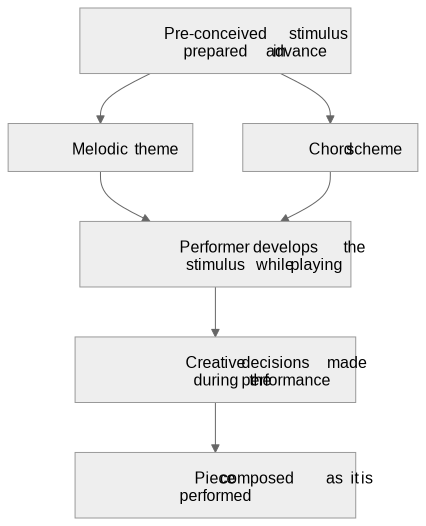
Key words
Say what each word means before you turn the card.
Composition during performance
Try answering aloud or in your head before turning the card.
Pre-conceived stimulus
Try answering aloud or in your head before turning the card.
Melodic theme as a starting point
Try answering aloud or in your head before turning the card.
Chord scheme as a starting point
Try answering aloud or in your head before turning the card.
See every definition
- Composition during performance
- A piece composed as it is performed, rather than fully written out in advance.
- Pre-conceived stimulus
- A plan or seed idea prepared beforehand, such as a melodic theme or chord scheme, that guides the performance.
- Melodic theme as a starting point
- A short tune the improviser develops as the stimulus for a piece composed during performance.
- Chord scheme as a starting point
- A sequence of chords to build on, acting as the stimulus for a piece composed during performance.
Label the diagram
Some boxes have lost their names. Pick the right name for each number.
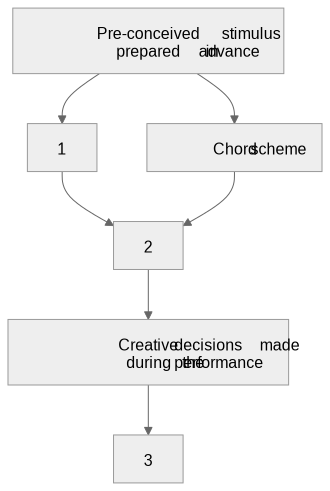
1Box 1
2Box 2
3Box 3
There is more to this lesson
The full lesson goes on to check your understanding and help you earn the marks. Create a free account to carry on, with your progress saved.
A week of Premium from your first lesson · Then the free plan continues · No card, no charge
Test your understanding of Appendix 3: Musical vocabulary - Dynamics and performance matters: A piece composed as it is performed, although frequently based on a pre-conceived ‘stimulus’ such as a melodic theme or chord scheme
Active recall beats re-reading. Take an instant quiz now to test what you’ve learned and lock it into long-term memory.
A week of Premium from your first lesson · Then the free plan continues · No card, no charge